Insights
Why Does My Dog Bark at Strangers?
Barking at strangers isn't one problem — it's at least three different ones that look identical from the outside.

Barking at strangers isn't one problem — it's at least three different ones that look identical from the outside.
"Why does my dog bark at strangers" is one of the most common questions dog owners search — and one of the hardest to answer generically, because the barking itself looks almost identical whether the underlying cause is fear, territorial guarding, frustrated greeting, or simple under-socialization. Treating all four the same way is why so many owners feel like nothing works.
The dog barks from a distance, often retreating while barking, body weight shifted backward, tail low. This is a request for the stranger to go away, not a threat display. Punishing this kind of barking suppresses the warning signal without addressing the underlying fear — which can produce a dog that bites without barking first, because barking got punished.
This shows up specifically at boundaries — the yard fence, the front window, the door — and largely stops once the stranger is out of the territory or, in some cases, once they're let inside and "accepted." Body language tends to be forward and confident rather than retreating. This is about space, not the person specifically.
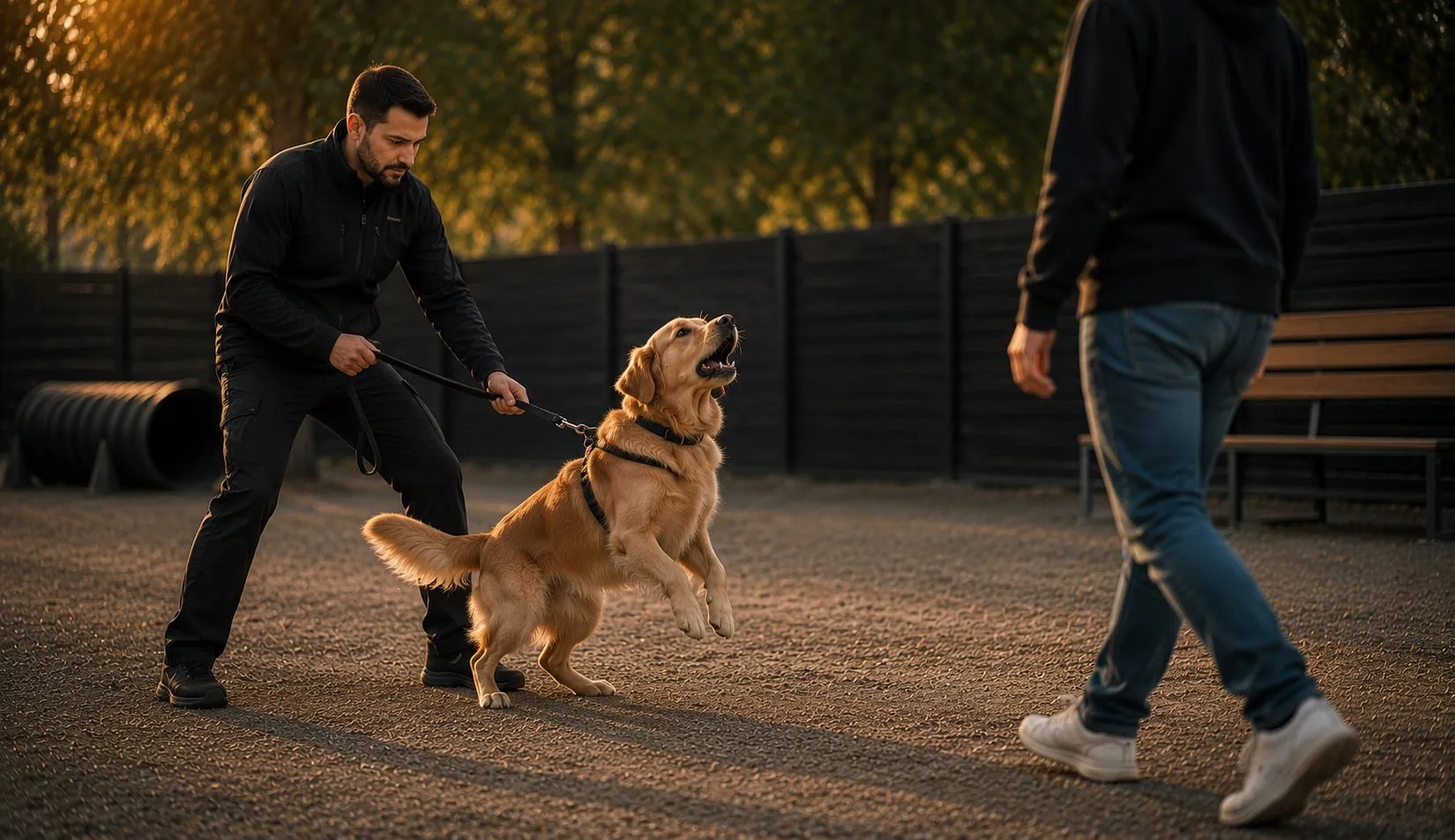
Some dogs bark at strangers because they want to greet them and can't — leash restraint or a barrier creates frustration that comes out as barking that looks aggressive but is closer to an overexcited toddler being held back from a toy. Tail is often loose and wagging, body forward and bouncy rather than stiff.
Dogs that simply weren't exposed to varied people during the critical socialization window (roughly 3-14 weeks) often bark at anything novel — hats, uniforms, beards, wheelchairs, strollers — because unfamiliar is processed as unsafe by default. This tends to be broader and less specific than the other three categories.
The fix for fear (build confidence at a distance the dog can handle, work closer gradually) is close to the opposite of the fix for territorial barking (manage the boundary and reward calm at the perimeter), and neither resembles the fix for frustrated greeting (teach an alternative behavior and control access to greeting). Guessing wrong, or applying generic "just correct the barking" advice, frequently makes the actual underlying issue worse.
This is exactly why evaluation comes before program placement. A dog presented as "barks at everyone" gets assessed for which of these categories — sometimes more than one — is actually driving it, through our behavior modification and behavior problems programs, before any protocol is applied.