İçgörüler
Yavru Tuvalet Eğitimi: Gerçekçi Bir Zaman Çizelgesi
Çoğu yavru 5-6 aya kadar güvenilir şekilde tuvalet eğitimini tamamlamaz — internetin vaat ettiği 2 hafta değil.

Çoğu yavru 5-6 aya kadar güvenilir şekilde tuvalet eğitimini tamamlamaz — internetin vaat ettiği 2 hafta değil.
Puppy potty training is one of the highest-searched dog training topics for a reason: it's frustrating, it feels like it should be simple, and most online advice sets expectations that no puppy actually meets. A realistic timeline changes how owners respond to accidents — and fewer angry reactions means faster progress.
Most puppies can hold their bladder for roughly one hour per month of age, up to about eight or nine hours as adults — meaning an 8-week-old puppy needs a potty break roughly every two hours, awake or asleep. Basic pattern recognition usually develops by 12-16 weeks. Genuine reliability, where accidents become rare rather than occasional, typically isn't consistent until 5-6 months, and some breeds take longer. A puppy having an accident at 10 weeks is on schedule, not behind.
The vast majority of accidents happen because the puppy had unsupervised access to space, not because the puppy "knew better and did it anyway." Puppies don't have the bladder control or the conceptual understanding to hold it out of spite. If a puppy is out of your direct line of sight and not confined, an accident is a management failure, not a training failure.
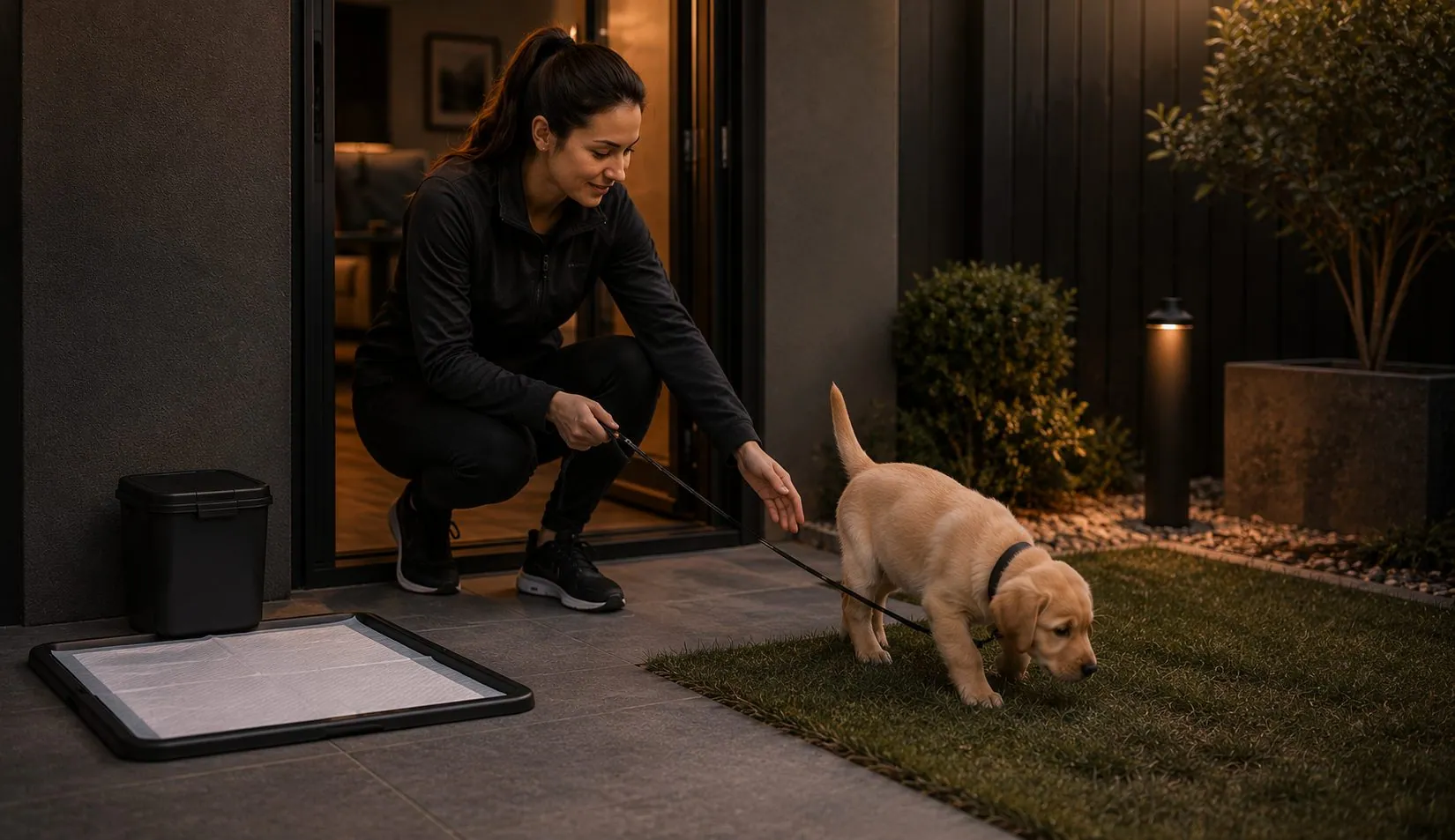
Take the puppy out on a fixed schedule (after waking, after eating, after playing, and every two hours in between), to the same spot, on a leash — not loose in the yard, where exploring competes with the actual task. Reward within seconds of the puppy finishing, not after walking back inside. A tight schedule for the first several weeks does more than any single training technique.
Punishing an accident after the fact teaches the puppy that your presence is dangerous when it needs to eliminate — which often produces puppies that hide to go, making the problem worse and harder to supervise. Cleaning without an enzymatic cleaner leaves scent markers that pull the puppy back to the same indoor spot.
House training is one of the first things we address in Puppy Training, built around this exact schedule-and-supervision framework rather than punishment. Getting this right early also builds the structure that everything else in the program depends on.